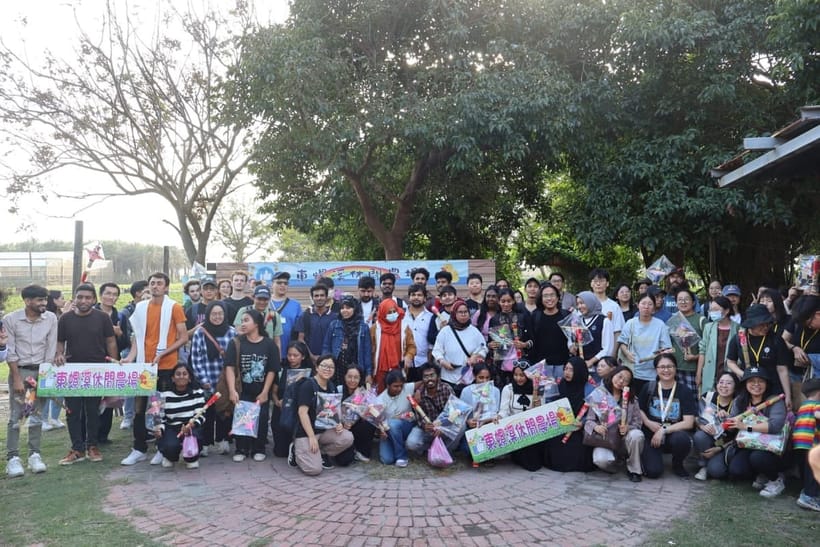
Projects by international students in the TEEP and IIPP programs.
Each year the lab hosts international students through two Taiwan government programs: TEEP (Taiwan Experience Education Program, Ministry of Education; the lab’s Taiwan–India project since 2018) and IIPP (International Internship Pilot Program, National Science and Technology Council; since 2024). These students arrive with different backgrounds, and the lab gives them a concrete project in which to apply AI to a real problem.
Projects span signal processing, time-series prediction, robotics and computer vision, typically built with Python notebooks and low-cost embedded hardware such as Arduino and ESP boards. Several have grown into collaborations or papers, for example the two-step authentication work presented at ICETA 2024.
What interns do. Typical tasks are digital signal processing (short-time Fourier transform, discrete wavelet transform, digital filtering), machine learning with LSTM and general regression neural networks, simulation and analysis in MATLAB and Python, and implementing them on embedded hardware such as FPGA boards. Interns report weekly and meet the group every week; C or C++ programming is expected.
Topics offered. Recent calls offered smart grids and power quality, and wavelet neural networks for the industrial internet of things (IIoT), both covering feature extraction, system-response identification and system-status identification; embedded image recognition (feature extraction, contour identification, object recognition); and AI and edge computing for the campus battery energy storage system.
Lets you in only when both your face and your voice match, with an ordinary webcam and microphone.
A two-step authentication design in which a VGG16 face classifier identifies an enrolled user and a ResCNN speaker encoder then verifies their voice, using only an ordinary webcam and microphone; published at ICETA 2024.
Takes the roll by recognizing faces through a webcam.
A Tkinter and OpenCV desktop app that captures face images, trains a recognizer, and logs attendance in real time to CSV files or a MySQL database, with manual entry as a fallback. Supported by TEEP.
Reads an ECG and tells heartbeat types apart on a low-cost microcontroller.
Wavelet-based preprocessing and feature extraction of ECG heartbeat signals, with ANN and CNN heartbeat classifiers deployed on low-cost microcontrollers (Arduino Nano, ESP8266 with MicroPython).
Learns how two campus buildings use electricity and predicts what they will use next.
Analysis and prediction of campus electricity consumption from September 2022 smart-meter data of two NCUE buildings (HT5 and HT9), implemented in a Jupyter notebook.
A small robot car that patrols on its own, holding a straight course and measuring distances with a laser sensor.
Design and construction of an autonomous patrol robot vehicle, using an MPU-6050 IMU with PID control to hold a straight course, VL53L-series distance sensing on ESP32, and Blynk-based monitoring.
Kuan Wei Chen, Ting Yi Lin, Wen Ren Yang, Aryan Kesarwani, Riya Singh
IET International Conference on Engineering Technologies and Applications (ICETA 2024), IET Conference Proceedings, vol. 2024, no. 22, pp. 11–12
Combines face and voice recognition into a low-cost authentication system for a small group that needs only a camera and a microphone: a face model identifies the user, then a speaker model verifies the voice. Code and models are public.
TEEP and IIPP interns on their time in the lab, as they wrote it.
Muskan
IIPP
Being part of Professor Wen Ren Yang’s AI lab has offered me hands-on experience that goes far beyond what I’d learn in a classroom. We work in small, diverse teams to create and test AI applications, which has taught me the importance of adaptability and cross-cultural collaboration. One memorable project involved developing a smart health monitoring system, where our team included members from multiple countries. This project helped me grow my technical skills while learning how to communicate effectively across cultures. Our professor’s mentorship has been invaluable; he pushes us to think critically and refine our approaches, encouraging both independence and teamwork. Additionally, the lab arranges workshops with industry experts, which has broadened my understanding of real-world AI applications. This experience has built a strong foundation for my career, equipping me with both technical knowledge and a global perspective.
Thank you for this incredible opportunity. The lab environment is excellent, and the research is highly engaging. I am very grateful to the Professor for their exceptional mentorship and for creating such a welcoming, collaborative space for interns.
Sneha Dombaranhalli Venkataramanaiah
TEEP
My experience in the lab has been truly wonderful. The welcoming and collaborative work environment makes learning enjoyable, and we are fortunate to have a highly supportive and knowledgeable professor who constantly guides, motivates, and encourages us throughout our research journey. I am grateful for this valuable learning experience and the opportunity to grow.
Sreevidya N
TEEP
The lab is very well equipped. I am glad that I got this opportunity to work here.
Abdul Samad
TEEP
The internship provided an excellent opportunity to enhance my knowledge and skills in artificial intelligence. The guidance and support from Professor Wen Ren Yang created an inspiring and collaborative environment that greatly contributed to my personal and professional growth
Pradyumn
TEEP
Working in the lab was a transformative experience. I gained valuable insights into AI and learned the importance of teamwork and innovation. The mentorship and structured approach under Professor Wen Ren Yang made it an unforgettable learning journey.
Mahima
TEEP
My time at the AI Application Lab was truly enriching. Professor Wen Ren Yang’s emphasis on learning and problem-solving helped me strengthen my foundation in artificial intelligence and improve my critical thinking skills.
SivaKumar
TEEP
The internship was a highly rewarding experience. The lab provided an environment filled with curiosity and exploration, where Professor Wen Ren Yang’s guidance was instrumental in helping me achieve my goals and grow as a learner.
Rajan Mahato
TEEP
Participating in the lab internship was an incredible experience. I developed a deeper understanding of AI concepts and methodologies while benefiting from Professor Wen Ren Yang’s encouragement and dedication to student development.
Aman
TEEP
This internship was an amazing opportunity to immerse myself in the field of AI. The supportive atmosphere and the focus on innovation under Professor Wen Ren Yang’s mentorship made the experience both enjoyable and educational.
Anagha
TEEP
The lab internship helped me sharpen my skills and broaden my understanding of AI. Professor Wen Ren Yang’s hands-on approach and commitment to excellence created a productive and motivating learning environment.
VinothKumar
TEEP
Interning in the lab was an invaluable experience. The emphasis on learning, coupled with Professor Wen Ren Yang’s thoughtful guidance, provided a strong foundation in AI and inspired me to continue exploring this field.
Nidhis
TEEP
My internship experience was both challenging and fulfilling. Professor Wen Ren Yang fostered a supportive and stimulating environment, which enabled me to develop technical expertise and confidence in applying AI concepts effectively.
Monica
TEEP
Working with Professor Wen Ren Yang’s AI Application Lab for the past six months has been an enriching experience that deepened my understanding of applied AI. I was initially drawn to the lab for its focus on impactful, real-world AI applications, and the experience has far surpassed my expectations. Through hands-on involvement in an AI-powered image recognition project, I gained practical skills and insights, especially within the lab's collaborative, curiosity-driven environment. Attending workshops and lectures by visiting professors and industry leaders further expanded my perspective on AI's rapidly evolving landscape. Professor Yang’s mentorship has encouraged me to tackle complex challenges, enhancing my problem-solving abilities. I’m grateful for the lab’s supportive and forward-looking atmosphere, where I’ve learned not only about AI but also about the skills essential for a future shaped by technology
Himanshu
TEEP
Working with Professor Wen Ren Yang’s AI Application Lab for the past six months has been an enriching experience that deepened my understanding of applied AI. I was initially drawn to the lab for its focus on impactful, real-world AI applications, and the experience has far surpassed my expectations. Through hands-on involvement in an AI-powered image recognition project, I gained practical skills and insights, especially within the lab's collaborative, curiosity-driven environment. Attending workshops and lectures by visiting professors and industry leaders further expanded my perspective on AI's rapidly evolving landscape. Professor Yang’s mentorship has encouraged me to tackle complex challenges, enhancing my problem-solving abilities. I’m grateful for the lab’s supportive and forward-looking atmosphere, where I’ve learned not only about AI but also about the skills essential for a future shaped by technology
Riya Singh
TEEP
Being part of Professor Wen Ren Yang’s AI Application Lab has been an immersive learning experience. I was initially drawn to the lab’s focus on applying AI in meaningful ways, and my time here has exceeded expectations. We are encouraged to attend workshops and lectures led by visiting professors and industry leaders, which has enhanced my understanding of AI’s evolving landscape. One of my most valuable experiences was contributing to an AI-powered image recognition project. The lab's collaborative environment fosters curiosity, making it a space for continuous improvement and exploration. Professor Yang’s mentorship has empowered me to take on challenges and embrace problem-solving. I am grateful for the lab’s supportive atmosphere, where learning extends beyond AI, preparing us for a future where AI plays a central role in technology.
Varshitha
TEEP
In Professor Yang’s lab, the journey is all about innovation and pushing boundaries. Our projects require us to stay updated with the latest advancements in AI, which is both exciting and challenging. One of the highlights of my experience was attending an international AI conference, where I presented our project on autonomous vehicles. The lab provided comprehensive support, from helping with presentation skills to refining our technical contributions. I have learned not only about algorithms and neural networks but also about project management and teamwork. Our professor encourages us to look at problems from multiple angles, making it a dynamic and stimulating environment to work in. The lab’s culture of inclusivity, collaboration, and rigorous research has broadened my perspective, allowing me to understand AI’s impact on society.
Gopika
TEEP
My experience in the AI Application Lab has been enriched by the cultural exchange that naturally happens here. Working with peers from different countries and backgrounds has been rewarding, as it gives us varied perspectives on approaching projects. One project I enjoyed was developing a language processing tool to support educational applications, which required understanding language nuances across cultures. Professor Yang emphasizes empathy in AI development, reminding us to consider how our work will affect users from diverse backgrounds. This approach has not only sharpened my technical skills but has also taught me to be mindful of the social implications of AI. Our lab often organizes team-building events, like cooking classes, where we share our cultures and build stronger connections. It’s a blend of professional and personal growth that makes every day inspiring.
Vathsala
TEEP
Fostering innovation is at the heart of Professor Yang's Artificial Intelligence Lab. I’ve had the opportunity to work on groundbreaking projects that push the limits of what I thought was possible. One of our projects involved using AI to analyze environmental data and predict trends in climate patterns, which was challenging and impactful. Professor Yang’s mentorship has been invaluable, guiding us through complex research methods and encouraging us to think creatively. The lab’s dynamic team ensures a balance between rigorous scientific research and practical application. I’ve honed my skills in machine learning, data analysis, and project management. Additionally, we collaborate with industry professionals and academics, providing us with perspectives beyond the lab. This lab is not just about research; it’s about making a difference through innovation
Vishal
TEEP
Being part of Professor Wen Ren Yang's Artificial Intelligence Application Lab has been transformative for my growth in both technical and interpersonal skills. I came into the lab with a strong interest in AI but minimal experience in applying these theories to real-world scenarios. Collaborating on projects, I’ve developed valuable AI models and learned to communicate complex concepts in simple terms. Our team’s diversity has been inspiring, as everyone brings unique insights that enhance our work. One of my most memorable experiences was co-developing a predictive AI model for healthcare. The project was challenging, but with the support and guidance of Professor Yang and my teammates, we achieved results that exceeded our expectations. The lab’s structure, with weekly presentations and feedback sessions, has allowed me to constantly improve and refine my approach. More than just a research space, this lab is a community of learning and growth.
Suraj Muccu
TEEP
“In Professor Yang’s lab, innovation and pushing boundaries are at the forefront of everything we do. Staying updated with the latest AI advancements is essential, which makes the work both exciting and challenging. One of my highlights was presenting our autonomous vehicle project at an international AI conference. The lab supported us with every aspect of our presentation, from refining our technical content to polishing our presentation skills. Here, I’ve learned so much—not only about algorithms and neural networks, but also about teamwork and project management. Professor Yang encourages us to view problems from multiple perspectives, creating a dynamic and stimulating environment for research. The lab’s culture of inclusivity and collaboration has broadened my understanding of AI's societal impact and provided me with a holistic view of the field.”
Chiranjeevi
TEEP
My experience in the AI Application Lab has been incredibly rewarding, thanks to the cross-cultural exchange that happens naturally here. Working with peers from different backgrounds has broadened my approach to problem-solving. One project I enjoyed involved developing a language processing tool for educational applications, where we considered language nuances across cultures. Professor Yang encourages us to think about empathy in AI development, reminding us to be mindful of the social impact of our work. This perspective has not only strengthened my technical skills but also made me more aware of AI's influence on society. Beyond the technical, the lab organizes team-building events where we share our cultures and strengthen our connections. For me, the lab is both a place for professional growth and a supportive community that values diversity and mutual learning.
Solomo
IIPP
My journey in Professor Yang’s AI Application Lab has been an immersive learning experience that constantly challenges me. The lab emphasizes practical applications of AI, encouraging us to tackle real-world problems with innovative solutions. One of the projects I worked on involved using AI to analyze climate data, helping us predict environmental trends. The experience was not only technically challenging but also profoundly impactful. Professor Yang’s guidance has been crucial, as he always inspires us to approach problems from new angles and think creatively. The lab’s collaborative culture is one of my favorite aspects—our team members come from diverse backgrounds, and each brings unique strengths. The exposure to interdisciplinary knowledge and real-world impact has helped me grow immensely, both as a researcher and as an individual dedicated to making a difference through AI.
Aleem
IIPP
Being part of Professor Wen Ren Yang's Artificial Intelligence Application Lab has been transformative for my growth in both technical and interpersonal skills. I came into the lab with a strong interest in AI but minimal experience in applying these theories to real-world scenarios. Collaborating on projects, I’ve developed valuable AI models and learned to communicate complex concepts in simple terms. Our team’s diversity has been inspiring, as everyone brings unique insights that enhance our work. One of my most memorable experiences was co-developing a predictive AI model for healthcare. The project was challenging, but with the support and guidance of Professor Yang and my teammates, we achieved results that exceeded our expectations. The lab’s structure, with weekly presentations and feedback sessions, has allowed me to constantly improve and refine my approach. More than just a research space, this lab is a community of learning and growth