
← All research areas

Research area

Biometrics and Security

Face and voice authentication, automated attendance and exam invigilation.

Ting-Yi Lin presenting the two-step voice and face authentication poster at the 2024 IET ICETA conference.

Identity checks are needed everywhere from building access to examination halls, yet passwords are easily shared and single biometrics can be spoofed. We look for systems that are secure enough to trust and light enough to run on inexpensive hardware.

Our systems combine face recognition and voice verification, and use lightweight networks for edge deployment. In the two-step authentication design, a VGG16 face classifier identifies the user and a ResCNN speaker encoder then verifies the voice; both steps must pass. The invigilation system pairs Swin-Transformer semantic segmentation with ShuffleNet V2 face identification to detect cheating behavior.

Representative projects, all on GitHub, are Two-Step Multi-Biometric Authentication (ICETA 2024), the Face Recognition Attendance Management System and Invigilation Using Lightweight Semantic Analysis.

Featured work

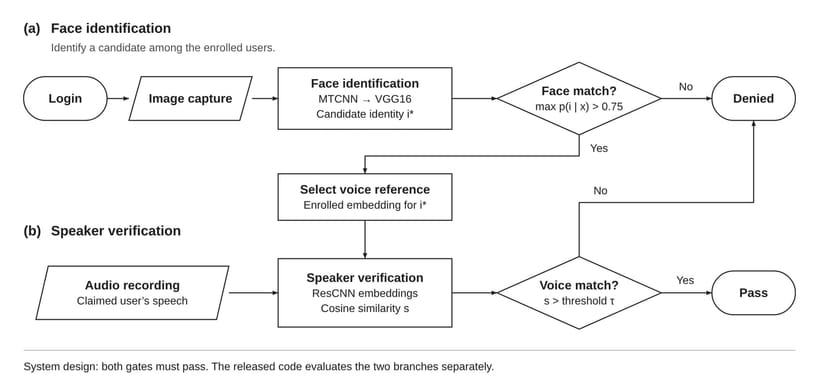
Flow chart in two rows. Face identification: login, image capture, MTCNN and VGG16 face identification giving a candidate identity, and a face-match check with probability above 0.75; no leads to denied. Yes selects that user's enrolled voice reference. Speaker verification: an audio recording and the reference go into ResCNN embeddings compared by cosine similarity; a voice-match check above a threshold leads to pass, otherwise denied. A note says both gates must pass and the released code evaluates the two branches separately.

Two-step authentication: face first, then voice

A face match picks the user's enrolled voice reference, and speaker verification must then pass as well; either failed check denies access. In the code release, face identification reaches about 95% accuracy on five enrolled students and speaker verification about 99% on LibriSpeech, each tested on its own. Figure from the code release.

View on GitHub
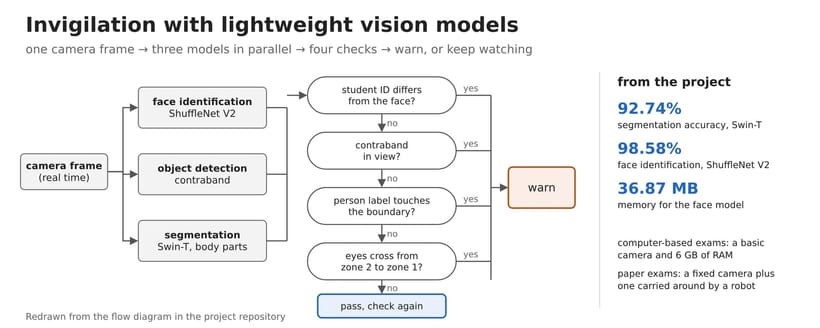
Flow chart. A real-time camera frame goes to three models in parallel: ShuffleNet V2 face identification, contraband object detection and Swin-T body segmentation. Four checks follow in turn: student ID differs from the face, contraband in view, a person label touches the boundary, eyes cross from zone 2 to zone 1. Any yes leads to a warning; four noes lead to pass and check again. A side panel lists 92.74% segmentation accuracy, 98.58% face identification accuracy, 36.87 MB for the face model, and the camera set-ups for computer-based and paper exams.

Exam invigilation on light hardware

Three models look at each camera frame: who the student is, whether a phone or earphones are in view, and where each body is. Four checks then decide whether to warn the invigilator. The models are small enough for edge devices. Redrawn from the flow diagram in the repository.

View on GitHub

Related projects

Lets you in only when both your face and your voice match, with an ordinary webcam and microphone.

A two-step authentication design in which a VGG16 face classifier identifies an enrolled user and a ResCNN speaker encoder then verifies their voice, using only an ordinary webcam and microphone; published at ICETA 2024.

People Kuan-Wei Chen, Ting-Yi Lin

Jupyter Notebook 9 Updated Oct 4, 2026

Related publications

  1. A Comparative Speech Signal Processing of Taiwanese and Indian Speech Characteristics for ASR and Speaker Verification

    Monica C, Wen-Ren Yang

    2025 IEEE International Conference on Consumer Electronics - Taiwan (ICCE-Taiwan), pp. 349–350

    Compares the speech of Taiwanese Mandarin–English bilinguals with Indian English speakers using MFCCs, pitch contours, spectrograms and wavelet analysis: Taiwanese speech shows more pitch variation and tonal shifts, Indian speech a steadier rhythm. The findings guide the choice of speech-recognition and speaker-verification models for diverse speakers.

  2. Two-step Authentication: Multi-biometric System Using Voice and Facial Recognition

    Kuan Wei Chen, Ting Yi Lin, Wen Ren Yang, Aryan Kesarwani, Riya Singh

    IET International Conference on Engineering Technologies and Applications (ICETA 2024), IET Conference Proceedings, vol. 2024, no. 22, pp. 11–12

    Combines face and voice recognition into a low-cost authentication system for a small group that needs only a camera and a microphone: a face model identifies the user, then a speaker model verifies the voice. Code and models are public.

Interested? Visit the lab or write to us.