AI and signal processing for the campus battery energy storage system, power quality and power electronics.
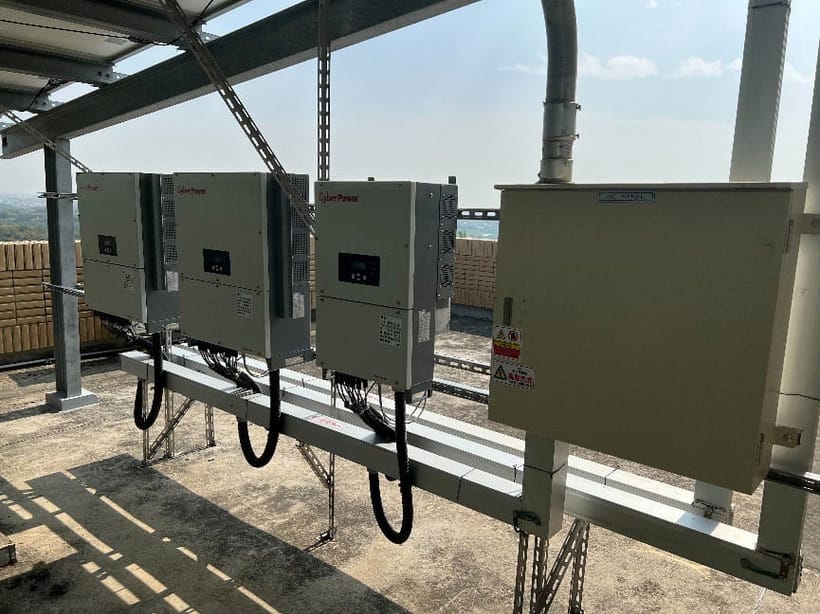
The NCUE campus runs a 1-MW battery energy storage system (BESS) alongside solar power; it was the first megawatt-scale BESS operated by a university in Asia. The lab applies AI and edge computing to its operation: edge devices process the measurements with the discrete wavelet transform (DWT), the short-time Fourier transform (STFT) and Huffman coding, and LSTM neural networks approximate and predict how the system behaves.
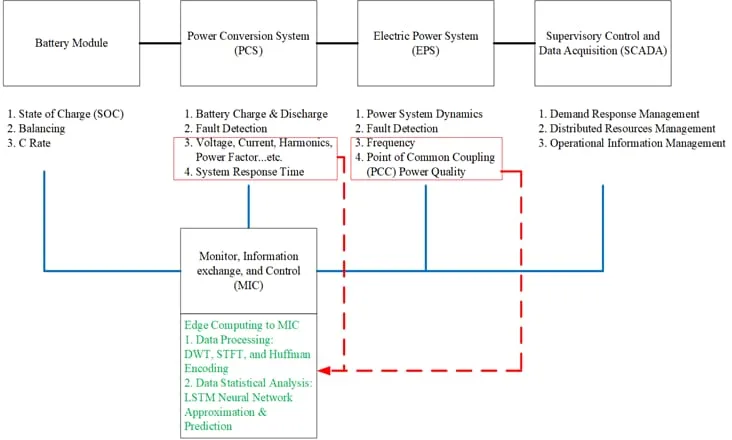
The work follows the whole chain: the battery modules (state of charge, balancing, C-rate), the power conversion system (charging and discharging, fault detection, voltage, current, harmonics and power factor), power-system dynamics and frequency, and power quality at the point of common coupling. The aim is a zero-energy campus, in line with UN Sustainable Development Goal 7 (affordable and clean energy), in particular targets 7.A (international cooperation that opens up clean-energy research and technology) and 7.B (expanding and upgrading infrastructure for modern, sustainable energy services). The lab’s international internships are one way it contributes to 7.A. The lab also measures and models supercapacitors and batteries.
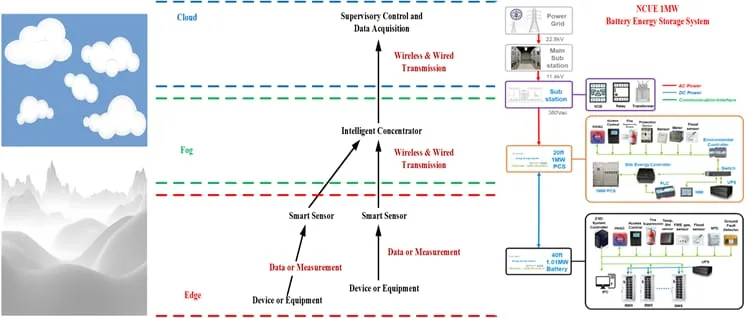
The monitoring system is organized in three layers. At the edge, smart sensors measure the devices and equipment; in the fog layer, an intelligent concentrator gathers their data over wired and wireless links; in the cloud, supervisory control and data acquisition (SCADA) handles demand response, distributed-resource management and operational information. A monitoring, information-exchange and control (MIC) module sits between the battery, the power conversion system and the grid, and runs the edge computing: data processing (DWT, STFT and Huffman coding) and data analysis (LSTM approximation and prediction).
The direction builds on Prof. Yang’s earlier work in power electronics and power quality, listed below: wavelet-based voltage-sag monitoring, flicker measurement, power-disturbance recognition with neural networks, flywheel energy storage, battery charging and resonant converters.
AI and Edge Computing for the Campus Battery Energy Storage System
Small computers beside the campus battery bank compress its measurements and forecast how it will behave.
Helping run the 1-MW battery energy storage system on the NCUE campus: edge devices process measurements with the discrete wavelet transform, short-time Fourier transform and Huffman coding, LSTM networks predict the system's behavior, and power quality is analyzed together with solar integration, toward a zero-energy campus (SDG 7).
Learns how two campus buildings use electricity and predicts what they will use next.
Analysis and prediction of campus electricity consumption from September 2022 smart-meter data of two NCUE buildings (HT5 and HT9), implemented in a Jupyter notebook.
2026 IEEE International Conference on Consumer Electronics - Taiwan (ICCE-Taiwan), pp. 459–460
Builds a physics-guided digital twin of a campus PV system with low-cost ESP32 and LoRa sensors: a physics model gives the theoretical output, an LSTM forecasts current harmonics (RMSE about 1.90), and the gap between the twin and the inverter flags faults such as thermal derating and cloud shading.
Schedules a solar-plus-battery system with model predictive control that raises self-consumption while limiting battery degradation and grid congestion. One-year simulations compare it with conventional rules and test how forecast errors affect it, with tightened constraints to absorb them.
2025 IEEE Industry Applications Society Annual Meeting (IAS), pp. 1–8
Builds a battery management system for series-connected storage from cascaded half-bridge multilevel converters and a DSP. Sorting-based level-shifted PWM sets each module's current so the cells stay within 0.1 V of each other while charging, discharging or idle, with no extra balancing circuit, and a faulty module is detected and bypassed.
IET International Conference on Engineering Technologies and Applications (ICETA 2024), IET Conference Proceedings, vol. 2024, no. 22, pp. 23–24
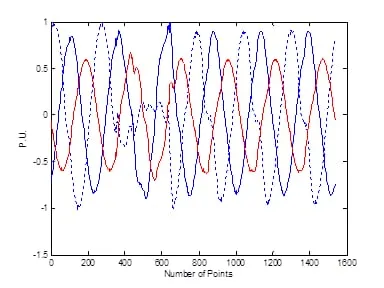
Uses a multi-input LSTM network to predict the current waveform and its harmonics in a solar power system, and shows in MATLAB that the predictions follow the variations across changing weather.
Forecasts grid frequency from the power use of each campus building: one ConvLSTM model per building, trained separately so each building's data stays private, combined by an ensemble into a campus-wide forecast that beats traditional methods on MSE, MAE and MAPE.
Extends the IEC 61400-21-1 flicker measurement for grid-connected wind turbines so it also gives ΔV10 values, as used in Japan and elsewhere; engineers can then estimate a turbine's flicker before installation and manufacturers can certify faster. Tested on a simulated doubly-fed induction generator turbine.
Liang-Rui Chen, Chung-Ming Young, Neng-Yi Chu, Ruey-Hsun Liang, Wen-Ren Yang
2010 International Power Electronics Conference (IPEC, ECCE Asia), pp. 2591–2597
Proposes a current-shared photovoltaic power system whose converter tracks the panel's maximum power point and regulates the load at the same time, raising efficiency and keeping critical loads supplied; a 200 W prototype confirms it at lower circuit cost.
2010 International Conference on System Science and Engineering (ICSSE), pp. 31–35
Compares the discrete wavelet transform with the short-time Fourier transform on two industrial signals, wafer microcracks and voltage sags, through experiments and simulation.
2010 International Power Electronics Conference (IPEC, ECCE Asia), pp. 92–98
Parallels two LLC series-resonant converters with interleaved PWM and a voltage-doubler output. This cuts ripple current and capacitor size, overcomes the high current stress of a single LLC stage, and keeps soft switching (ZVS and ZCS) for high-current, high-voltage outputs.
2010 5th IEEE Conference on Industrial Electronics and Applications (ICIEA), pp. 1198–1203
Builds a high-frequency sinusoidal supply for contactless power transfer from an LLC resonant tank that uses the coupled transformer's own inductances. A dsPIC tracks the resonant frequency across a 2 mm air gap, and a 1 kW prototype delivers maximum power to varying loads at about 95% efficiency.
2009 4th IEEE Conference on Industrial Electronics and Applications (ICIEA), pp. 3378–3381
Finds the best charging frequency for Li-ion batteries by AC impedance measurement: it is the frequency of minimum impedance, and charging there improves charging time and efficiency by about 30%.
W. R. Yang, M. H. Hu, G. W. Jhang, Z. Y. He, K. Y. Huang, C. S. Wang, L. R. Chen, T. Y. Guo, C. P. Young
2009 International Conference on Power Electronics and Drive Systems (PEDS), pp. 956–961
Monitors voltage sags in real time with a discrete wavelet transform on an embedded chipset that marks where each sag starts and ends, and compensates them with a flywheel energy storage system, shown in a proof-of-principle experiment.
Proceedings of the International MultiConference of Engineers and Computer Scientists 2009 (IMECS 2009), Vol. II, Hong Kong, pp. 1573–1577
Recognizes seven kinds of power disturbance (flicker, harmonics, interruption, dip, surge, swell and a clean sine) by decomposing each waveform with the DWT, reducing each level to its energy with Parseval's theorem, and classifying the energies with a probabilistic neural network; recognition rates are 86% or higher.
2008 IEEE International Conference on Industrial Technology (ICIT), pp. 1–6
Adds reflex (pulse) charging with energy recovery to the bidirectional converter of a UPS, so the negative-pulse energy is recovered instead of wasted. A 400 W prototype charges the battery about 10% more efficiently and 8.8% faster than a typical converter.
2008 IEEE International Conference on Industrial Technology (ICIT), pp. 1–5
Examines the ΔV10 method, used for decades in several Asian countries to rate voltage flicker and unchanged since 1978, against the IEC flickermeter standard, and shows where its readings become unreliable.
Wen-Ren Yang, Robert O'Connell, Chau-Shing Wang, Liang-Rui Chen
2008 IEEE International Conference on Industrial Technology (ICIT), pp. 1–6
Designs a mixed-signal chip for voltage-sag monitoring at many points of a transmission system: an analog front end for data acquisition and a digital discrete-wavelet-transform core. In simulation on IEEE P1159.2 sag waveforms, the wavelet decides faster than an RMS calculation.
2008 IEEE International Symposium on Industrial Electronics (ISIE), pp. 293–298
Models the magnetic coupling of a contactless power transmission system, compares converter topologies and compensation circuits to choose the main circuit, and confirms a design that delivers 31 V at 11 A.