← All research areas

Research area

Biomedical AI

AI for biosignals and speech: muscle-abnormality detection and multimodal emotion recognition.

Biosignals and speech carry information about a person’s physical and emotional state, but they are noisy, vary between individuals and must often be analyzed on small devices. The goal is models that are accurate, efficient and respect privacy.

Our work covers muscle-abnormality detection from biosignals, and multimodal emotion recognition from speech and text. For emotion recognition we compare Mamba state-space models with Transformers on text and audio, and predict a joint valence-arousal probability distribution rather than a single label. Earlier work uses wavelet transforms with neural networks to analyze ECG heartbeat signals on low-cost microcontrollers.

Representative work includes the EchoMind Mamba-VA-SER code release, which accompanies the preprint “Emotion as a Distribution” (arXiv:2609.05755), and the Embedded Wavelet Neural Network for ECG Analysis repository. Both are linked from the projects page: EchoMind-Mamba-VA-SER and ECG wavelet neural network.

Earlier master’s theses bring the same tools to health care: a wavelet neural network that recognizes infant crying patterns, indoor positioning of newborns in an obstetrics ward over the Internet of Medical Things, facial emotion recognition with YOLOv5 transfer learning, and the comparison of classical and deep-learning methods for EMG muscle-fatigue detection.

Featured work

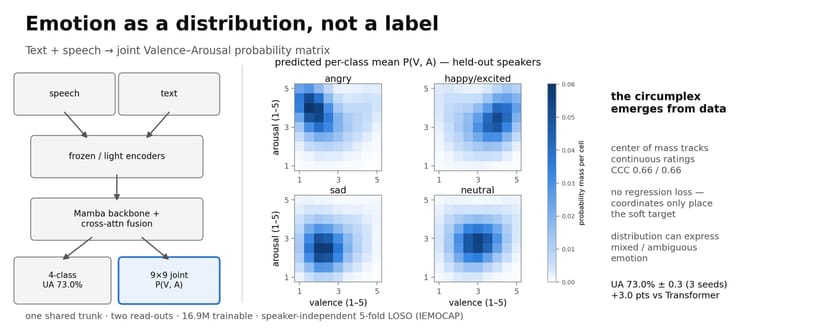
EchoMind overview. Speech and text go through light encoders into a Mamba backbone with cross-attention fusion, which gives a four-class decision and a 9×9 joint valence-arousal probability matrix. Four heat maps show the predicted mean matrix for angry, happy or excited, sad and neutral speech from held-out speakers.

EchoMind: emotion as a distribution, not a label

Text and speech go into a bidirectional Mamba model, which answers with one of four emotions and a 9×9 valence-arousal probability map. Figure from the code release.

View on GitHub
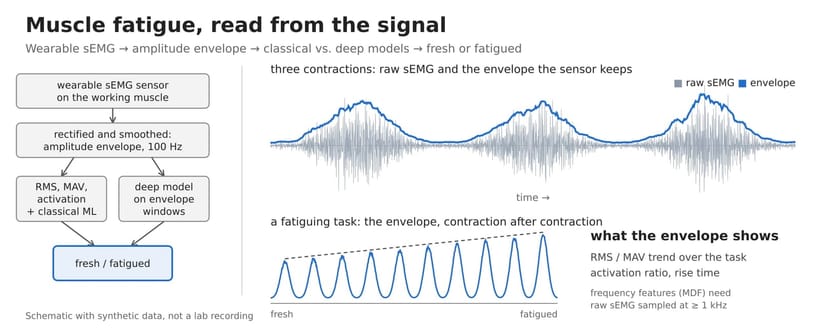
Schematic of muscle-fatigue detection. A wearable sEMG sensor keeps the rectified and smoothed amplitude envelope at 100 Hz; then either RMS, MAV and activation features with classical machine learning, or a deep model on envelope windows, decides fresh or fatigued. Beside it, three contractions of raw sEMG with the envelope traced over them, and the envelope of a fatiguing task whose peaks climb from one contraction to the next.

Muscle fatigue from surface EMG

A wearable sensor records the amplitude envelope of the muscle signal, and fatigue shows up in how that amplitude changes over a task. We compare classical features with deep models for detecting it. The figure is a schematic drawn from synthetic data.

Read more

Related projects

Hears how someone feels from both what they say and how they say it, and answers with a spread of likely emotions instead of one label.

Bidirectional Mamba versus Transformer backbones for text-and-audio emotion recognition on IEMOCAP, with a joint valence-arousal probability head; code release for the arXiv preprint 2609.05755.

People Kuan-Wei Chen, Ting-Yi Lin

Python 1 Updated Nov 5, 2026

Related publications

  1. Emotion as a Distribution: Joint Valence-Arousal Probability Learning for Speaker-Independent Multimodal Emotion Recognition

    Tingyi Lin, Wen-Ren Yang, Kuanwei Chen

    arXiv:2609.05755 (submitted to Speech Communication), 2026

    Treats a speaker's emotion as a distribution: besides one of four classes, the model outputs a 9×9 probability map over valence and arousal. On IEMOCAP text and speech, evaluated across speakers, the dual-head model reaches 73.0% unweighted accuracy, 3 points above a Transformer fusion baseline, and 76.6% with frozen WavLM features.

Interested? Visit the lab or write to us.