Wavelet transforms and digital signal processing for power, industrial, motion and acoustic signals, often paired with neural networks.
Real measurements rarely stay still. A voltage sag lasts a few cycles, a microcrack shows up as a brief burst in a sensor trace, and a bird call is a short chirp in hours of farm noise. Methods that look at a whole signal at once, such as the ordinary Fourier transform, blur these short events. Wavelet transforms describe a signal in time and frequency together, so a transient can be located and measured where it happens.
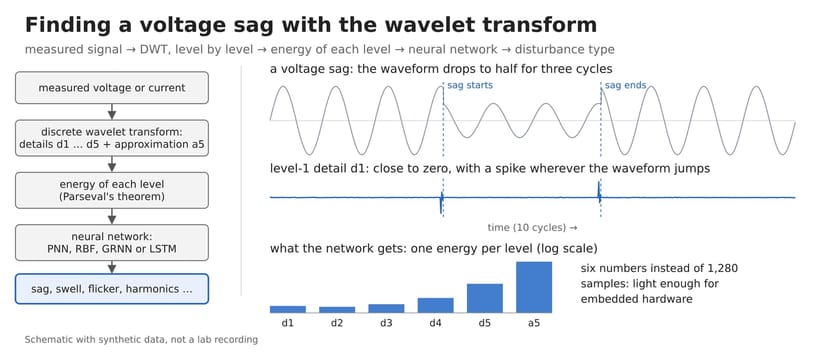
This is Prof. Yang’s core field. The lab uses the discrete wavelet transform (DWT) and the short-time Fourier transform (STFT) to extract features from measured signals, then classifies or regresses them with neural networks: probabilistic and radial-basis networks, wavelet neural networks, and more recently LSTMs. Because many of these systems run next to the machine they monitor, the processing is designed to fit on embedded hardware, down to a mixed-signal integrated-circuit design for wavelet-based monitoring.
The same tools have been applied to many kinds of signals: voltage sags, flicker and other power disturbances; wafer microcracks, probe marks and wet-etching flow rates in semiconductor manufacturing; textile production lines; human motion patterns; pest-bird sounds on a grape farm; and speech. Two current lines of work carry this forward: wavelet neural networks for the Industrial Internet of Things, which extract features from machine signals to identify a system’s response and status, and wavelet neural networks for embedded image recognition, from feature extraction to contour identification and object recognition. The papers are listed below. The work feeds directly into the lab’s smart grid and energy storage and biomedical AI directions.
Reads an ECG and tells heartbeat types apart on a low-cost microcontroller.
Wavelet-based preprocessing and feature extraction of ECG heartbeat signals, with ANN and CNN heartbeat classifiers deployed on low-cost microcontrollers (Arduino Nano, ESP8266 with MicroPython).
2025 IEEE International Conference on Consumer Electronics - Taiwan (ICCE-Taiwan), pp. 349–350
Compares the speech of Taiwanese Mandarin–English bilinguals with Indian English speakers using MFCCs, pitch contours, spectrograms and wavelet analysis: Taiwanese speech shows more pitch variation and tonal shifts, Indian speech a steadier rhythm. The findings guide the choice of speech-recognition and speaker-verification models for diverse speakers.
IET International Conference on Engineering Technologies and Applications (ICETA 2023)
Detects mynah birds in a vineyard from their calls with deep learning on an RP2040 microcontroller, estimates their distance with ultrasonic sensors, and can send a robot vehicle with red lasers to chase them away.
Nagaraj V. Dharwadkar, Anagha R. Pakhare, Vinothkumar Veeramani, Wen-Ren Yang, Rajinder Kumar Mallayya Math
Journal of Cases on Information Technology, vol. 24, no. 3, pp. 1–26, 2022
Monitors a textile production line mapped to smart-grid standards: the DWT removes noise from the line's operating signals, and their energy distribution feeds a general regression neural network that forecasts the time series.
Extends the IEC 61400-21-1 flicker measurement for grid-connected wind turbines so it also gives ΔV10 values, as used in Japan and elsewhere; engineers can then estimate a turbine's flicker before installation and manufacturers can certify faster. Tested on a simulated doubly-fed induction generator turbine.
IEEE Transactions on Consumer Electronics, vol. 65, no. 2, pp. 170–178, 2019
Recognizes human motion from a three-axis accelerometer for fitness assistance and elderly activity monitoring: the DWT extracts vibration features, their local energy feeds a multi-channel radial-basis neural network, and the wavelet step keeps the computation light.
IEEE Transactions on Instrumentation and Measurement, vol. 61, no. 4, pp. 865–875, 2012
Classifies the flow rate of a single-wafer wet-etching tool automatically: the flow meter's signal is decomposed with the DWT, the coefficient power goes into a radial-basis neural network, and a digital filter with a threshold refines the result, for in-situ monitoring in the fab.
2010 5th IEEE Conference on Industrial Electronics and Applications (ICIEA), pp. 414–419
Measures the area of the marks that test needles leave on wafer pads from high-magnification microscope images, replacing the manual practice of drawing an oval around each mark; the method is faster, more accurate and does not vary from person to person.
2010 International Conference on System Science and Engineering (ICSSE), pp. 31–35
Compares the discrete wavelet transform with the short-time Fourier transform on two industrial signals, wafer microcracks and voltage sags, through experiments and simulation.
2010 5th IEEE Conference on Industrial Electronics and Applications (ICIEA), pp. 1780–1785
Designs the optics of the wafer microcrack detector (a cylindrical lens with a solid immersion lens) and its signal processing: a probabilistic neural network separates vibration-induced deviations, and a short-time discrete wavelet transform identifies the cracks.
Proceedings of the International MultiConference of Engineers and Computer Scientists 2009 (IMECS 2009), Vol. II, Hong Kong, pp. 1573–1577
Recognizes seven kinds of power disturbance (flicker, harmonics, interruption, dip, surge, swell and a clean sine) by decomposing each waveform with the DWT, reducing each level to its energy with Parseval's theorem, and classifying the energies with a probabilistic neural network; recognition rates are 86% or higher.
2009 IEEE International Symposium on Industrial Electronics (ISIE), pp. 2069–2074
Builds a real-time in-line microcrack detector for wafers that scans line by line instead of processing images, and develops a short-time discrete wavelet transform (STDWT) that picks out a crack's reflection with little computation.
2008 IEEE International Conference on Industrial Technology (ICIT), pp. 1–5
Examines the ΔV10 method, used for decades in several Asian countries to rate voltage flicker and unchanged since 1978, against the IEC flickermeter standard, and shows where its readings become unreliable.
Wen-Ren Yang, Robert O'Connell, Chau-Shing Wang, Liang-Rui Chen
2008 IEEE International Conference on Industrial Technology (ICIT), pp. 1–6
Designs a mixed-signal chip for voltage-sag monitoring at many points of a transmission system: an analog front end for data acquisition and a digital discrete-wavelet-transform core. In simulation on IEEE P1159.2 sag waveforms, the wavelet decides faster than an RMS calculation.